
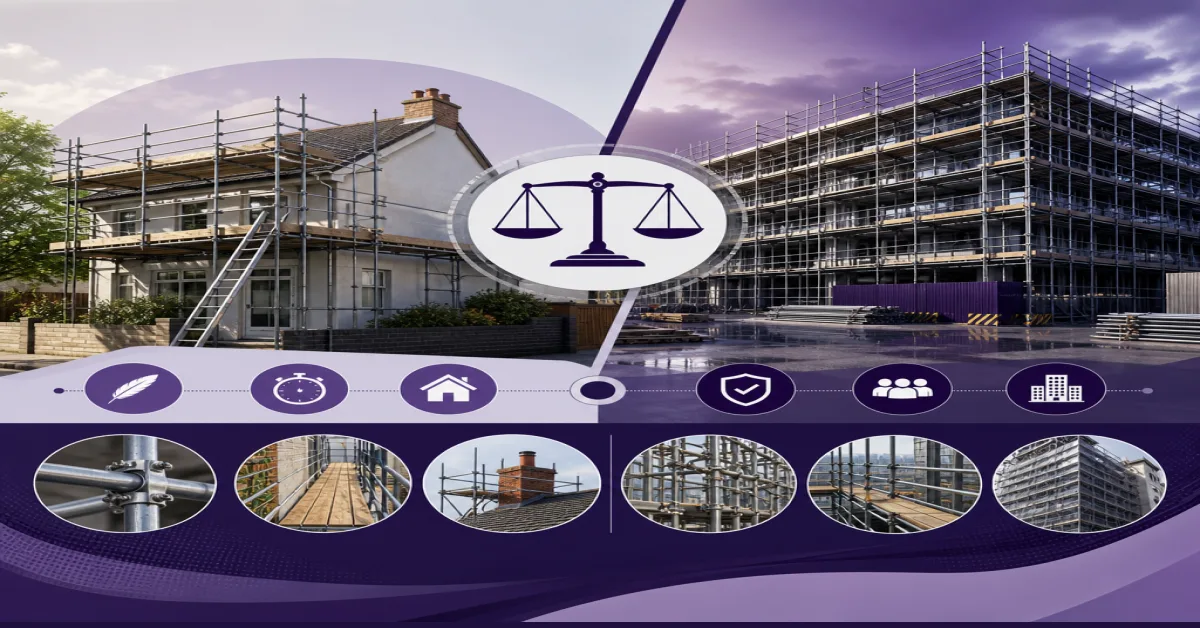
Guide & Comparison
Commercial vs Domestic Scaffolding: Key Differences
A detailed comparison of scaffolding specifications, covering load capacity, safety compliance, and cost differences for residential and commercial projects.
Residential
What Is Domestic Scaffolding?
Domestic scaffolding is scaffolding designed for residential properties: houses, flats, and small buildings. It provides safe access for roof repairs, painting, guttering, chimney work, and home extensions. Domestic scaffolds are lighter, simpler, and quicker to erect than commercial counterparts, typically using tube and fitting or lightweight system scaffolds.
"Domestic" refers to the building type and project scope, not the scaffold system itself. Domestic projects can still use commercial-grade components where site conditions demand it, such as a narrow alleyway or a steeply pitched roof requiring additional stability.
Typical applications include:
- Roof repairs and replacements
- External painting and decorating
- Guttering and fascia work
- Chimney repairs
- Home extensions and loft conversions
Typical cost: £600–£900 per week including erection, hire, and dismantling.
Commercial / Industrial
What Is Commercial Scaffolding?
Commercial scaffolding is the engineered, higher-capacity category serving offices, retail units, industrial buildings, and large developments. It is engineered for higher loads, longer durations, and more complex configurations than domestic scaffolding, and is not simply "bigger domestic scaffolding"—it is a different engineering category with bespoke design, formal compliance, and dedicated project management.
Commercial projects often involve public protection, multiple work fronts, and coordination with other trades. Each commercial scaffold is a bespoke structure with structural calculations behind it, designed to meet specific load and access requirements.
Typical applications and characteristics include:
- Office and retail building maintenance
- Industrial plant access and maintenance
- New-build construction support
- Public protection measures such as walkways and gantries
- Bespoke engineered design with structural calculations
- Dedicated project management and coordination
Typical cost: Starting around £2,000, often exceeding £10,000 for large projects.
You can review current commercial options on our commercial scaffolding services page.
Side-by-Side
Key Differences at a Glance
The table below is the single source of truth for specification differences. Site-specific factors can move a project between categories, so treat it as a general guide rather than a specification document.
Domestic
- Load capacityLighter duty
- DesignStandard configurations
- Public protectionMinimal
- DurationDays to weeks
- InspectionsWeekly
- Cost£600–£900 typical
- PermitsRarely needed
Commercial
- Load capacityHeavy duty, engineered
- DesignBespoke engineered design
- Public protectionWalkways, gantries, netting
- DurationWeeks to months
- InspectionsWeekly plus handover
- CostFrom £2,000, often £10,000+
- PermitsOften required
| Factor | Domestic | Commercial |
|---|---|---|
| Load capacity | Lighter duty | Heavy duty, engineered |
| Design | Standard configurations | Bespoke engineered design |
| Public protection | Minimal | Walkways, gantries, netting |
| Duration | Days to weeks | Weeks to months |
| Inspections | Weekly | Weekly plus handover |
| Cost | £600–£900 typical | From £2,000, often £10,000+ |
| Permits | Rarely needed | Often required |
Engineering
Load Capacity and Design
Domestic scaffolds use standard configurations with tube and fitting or lightweight system scaffolds, carrying workers, light materials, and tools. Commercial scaffolds are engineered for specific loads: heavy materials, multiple trades working simultaneously, and sometimes plant equipment.
Commercial scaffolds on city centre buildings are bespoke structures with structural calculations behind them. System scaffolds such as Cuplock, Ringlock, and Kwikstage are common in commercial work, while tube and fitting is typical for domestic projects.
Domestic
- •Workers, light materials, tools
- •Standard configurations
- •Tube and fitting or lightweight systems
- •1-2 workers per lift typical
Commercial
- •Heavy materials, multiple trades, plant
- •Bespoke engineered design
- •Cuplock, Ringlock, or Kwikstage systems
- •Concentrated loads from hoists & staging
The "3 to 1 rule" applies to both categories: a scaffold's total height must be no more than three times its minimum base dimension unless secured to the building. This is a fundamental stability check.
Safety & Legal
Public Safety and Compliance
A domestic scaffold in a garden or against a house rarely affects the public, which is why public protection is the biggest practical difference between the two categories. A commercial scaffold on a busy street must include pedestrian walkways and protection gantries, debris netting and sheeting, hoardings or barriers, street works licences from the council, and coordination with traffic management.
A pedestrian walkway protects the public from falling debris and scaffold components, requiring additional materials, design consideration, and often a street works licence from the council.
Public protection measures include:
- Pedestrian walkways
- Protection gantries
- Debris netting & sheeting
- Hoardings or barriers
- Street works licences
- Traffic management
- Warning signage & lighting
UK Compliance Callout
- NASC: Membership indicates adherence to industry best practice.
- CISRS: Certification confirms labour competence and recognised training.
- Work at Height Regulations 2005: The primary UK regulation governing scaffolding safety.
- CDM Regulations 2015: Apply to commercial projects, placing legal duties on clients and contractors.
Process
Duration and Project Management
Domestic projects typically run for days or a few weeks, while commercial projects can run for months with the scaffold erected in phases as building work progresses. Commercial scaffolding is a managed service, not just a hire—the project management overhead is a significant part of what you are paying for.
Commercial scaffolding often needs a dedicated project manager, delivery schedules, coordination with other contractors, phased erection, and handover inspections.
Dedicated project manager
Single point of contact ensuring the scaffold remains compliant and functional.
Phased erection & delivery
Sections handed over for use while others are completed, with scheduled deliveries.
Coordination & inspections
Liaising with contractors, weekly inspections, and handover documentation.
Book early for best results
Domestic scaffolding typically requires a few days' notice; commercial projects should be booked several weeks ahead to allow for design, permits, and material delivery. Ensure the site is clear of obstructions and flag fragile roof areas or ground conditions to the provider.
Investment
Cost Differences
Domestic
£600–£900
per week including erection & dismantling
Commercial
From £2,000
often exceeding £10,000 for large projects
You are paying for engineering, safety, and compliance, not just materials. A commercial scaffold can cost 10–20 times more than a domestic one because of the factors below.
Design complexity
Structural calculations and bespoke engineering for commercial; pre-engineered standards for domestic.
Public protection
Walkways, gantries, netting, and hoardings add significant material and labour costs.
Duration
Weeks vs months on site; longer hire periods accumulate weekly charges.
Project management
Dedicated manager and coordination overhead built into commercial pricing.
Manchester city centre note: Projects often require street works licences and traffic management coordination, which add cost. When comparing quotes, ensure they include the same scope of public protection and compliance documentation.
Decision Guide
Which Do You Need?
Self-Assessment
- 1.Is the building residential or commercial?
- 2.Will the scaffold affect public areas?
- 3.How long will the work take?
- 4.What loads will the scaffold carry?
Common Mistakes to Avoid
- Choosing domestic for commercial work
- Ignoring public protection requirements
- Failing to check provider credentials
- Not requesting a site survey
- Assuming cheapest quote is best value
Questions to Ask Your Provider
- Do you have experience with similar projects?
- Are you NASC members?
- Is your labour CISRS-certified?
- Do you handle permits and traffic management?
- Is a free site survey available?
- Will you provide a method statement & risk assessment?
If you are unsure which category applies, request a professional survey. Our residential scaffolding services page covers domestic projects, while commercial work is detailed on our commercial scaffolding page.
FAQ
Frequently Asked Questions
What is the 3 to 1 rule for scaffolding?
The 3 to 1 rule states that a scaffold's total height must be no more than three times its minimum base dimension unless it is secured to the building. This rule applies to both domestic and commercial scaffolds and is a key safety consideration. For example, a free-standing scaffold 6 metres tall needs a minimum base width of 2 metres.
What are the 7 types of scaffolding?
The seven common types are tube and fitting, system scaffolding (Cuplock, Ringlock, Kwikstage), frame scaffolding, suspended scaffolding, mobile scaffolding, cantilever scaffolding, and shoring. Domestic projects typically use tube and fitting or lightweight systems, while commercial projects favour system scaffolds for their load capacity and erection speed.
What is the most widely used scaffold system?
System scaffolding, particularly Cuplock and Ringlock, is the most widely used in commercial work because of its load capacity and erection speed. Tube and fitting remains common for domestic and bespoke work where adaptability matters more than speed.
What are the 6 types of scaffolding and their uses?
Six main types are: tube and fitting (versatile), system scaffolds (high load capacity), frame scaffolds (quick assembly), suspended scaffolds (facade access), mobile towers (internal maintenance), and cantilever scaffolds (ground obstructions). The choice depends on the building structure.
What is the difference between commercial and domestic scaffolding?
Commercial scaffolding is engineered for higher loads, longer durations, and complex configurations with public protection and formal compliance. Domestic scaffolding is lighter, simpler, and quicker to erect for residential projects.
How much does commercial scaffolding cost?
Commercial scaffolding starts around £2,000 and can exceed £10,000 for large projects. Costs are driven by design complexity, public protection, duration, project management, and compliance documentation.
How much does domestic scaffolding cost?
Domestic scaffolding for a typical three-bedroom house costs between £600 and £900 per week including erection, hire, and dismantling. Complex projects may cost more.
Do I need a permit for scaffolding in Manchester?
Domestic scaffolds rarely need permits. Commercial scaffolds in Manchester city centre or on public highways often require street works licences from the council and coordination with traffic management.
What is the difference between tube and fitting and system scaffolding?
Tube and fitting uses individual tubes and couplers for maximum flexibility. System scaffolding uses pre-engineered components with fixed connections, offering higher load capacity and faster erection for commercial projects.
How long can scaffolding stay up?
Scaffolding can stay up for the duration of the project, from a few days to several months. Inspections are required every seven days and after any alteration, damage, or adverse weather.
Unsure Which Scaffold You Need?
Talk to our team for a free, no-obligation site survey. We'll help you determine the right specification for your project.