
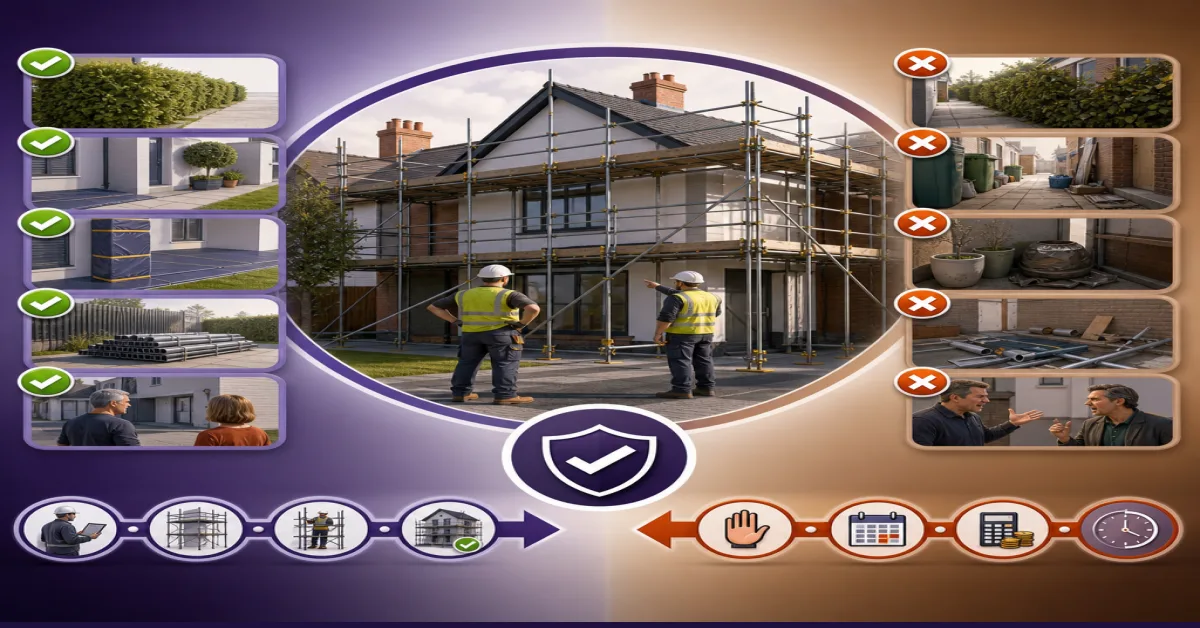
Property Preparation for Professional Scaffold Erection
Learn how to prepare your home for scaffolding. A complete guide to clearing access, protecting fragile items, and managing space for safe scaffold erection.
Understanding Your Role
What Property Preparation for Scaffold Erection Actually Means
Property preparation for scaffold erection is your responsibility to clear, protect, and secure the physical areas of and around your property so the scaffold contractor can erect, inspect, and dismantle the structure safely and without delay. The contractor handles the technical scaffold design, erection, and compliance; you handle the site access, physical clearance, and neighbour coordination.
Proper preparation makes erection faster, safer, and less disruptive. Poor preparation causes delays, and delays cost money through re-attendance charges and pushed-back work schedules. A scaffold crew that arrives to find a blocked driveway, locked gates, or overhanging branches may not be able to start at all, and you will be charged for the wasted visit. This guide walks you through the full process chronologically: before arrival, on the day, during the hire period, and before dismantling.
Most scaffolding advice online is written for construction professionals, not property owners. This guide is written for UK property owners, with UK regulations and housing contexts in mind, so you know exactly what to do on your side of the job. Book your scaffold at least 2-3 weeks in advance, especially during peak season (spring and summer), so you have time to complete every step in this guide before the crew arrives.
Space Planning
The Scaffold Footprint: How Much Space You Actually Need to Clear
A typical residential scaffold extends roughly 1.2 metres from the wall, with additional space needed for access ladders, materials storage, and worker movement. Most people clear a narrow strip against the wall and miss the wider footprint the scaffold actually occupies. For a three-storey house, the footprint can be 2-3 metres wide along the entire elevation being worked on.
Walk around your property and imagine a corridor roughly 1.5 metres wide around the building. Anything in that corridor needs to move. The scaffold footprint runs along the entire elevation being worked on, not just a small section — if the scaffolders are working on the whole roof, the cleared area must run the full length of that side of the house.
Three things make the footprint larger than you might expect:
Taller Scaffolds Need More Ground Space
The taller the scaffold, the more ground space it needs for stability — this is the "4 to 1 rule" in plain English. For every four units of height, the base needs one unit of width. A three-storey scaffold can easily need 2-3 metres of clear ground even though the wall itself is only 300mm deep. This is why the cleared area may be larger than the wall section being worked on.
The Delivery Lorry Needs Access Space Too
It needs to pull up close enough to unload materials, and it needs room to manoeuvre. Check for width restrictions, low bridges, or weight limits on your street that could prevent the lorry from getting close enough.
Workers Need Movement Space
They carry materials, climb ladders, and pass tools along the structure, so the cleared corridor must stay clear throughout the job. If you have a flower bed directly against the house, expect it to be trampled or covered with boards.
Your Action Plan
Your Preparation Checklist: What to Do Before the Scaffolders Arrive
Work through this checklist in the days before erection, in priority order. Each step takes only a few minutes, but skipping any of them can delay the job or cause damage.
Clear the Access Route
Move vehicles away from the property, ideally the day before. A car left in the driveway can delay the job by hours — the crew simply cannot work around it, and they will likely leave and charge you for re-attendance.
Clear garden furniture, planters, and ornaments from the working area. Trim back overhanging branches that could interfere with the scaffold, and remove washing lines, satellite dishes, or other fixtures in the way.
Trim what you can safely reach yourself; for larger trees, tell the contractor — they may have solutions or advise on timing. A locked gate can mean scaffolders cannot access the rear of the property, so make sure all access points are open on the day.
Protect Fragile Items
Move hanging baskets and window boxes before work begins — they will be in the way of the scaffold and are easily crushed.
Remove or secure loose roof tiles if you can do so safely; if you notice loose tiles but cannot reach them, tell the contractor so they can work around them.
Cover ponds or delicate planting with boards if the scaffold crosses them. Scaffolders use rubber pads and boards to protect surfaces, but fragile items should be moved rather than risk damage.
Secure the Property
Lock windows and doors that the scaffold will pass. Remove valuable items from sheds or outbuildings near the scaffold.
Consider security lighting if the scaffold will be in place for weeks, as a scaffold can provide access to upper-floor windows for an opportunistic thief.
If you have a burglar alarm, make sure the scaffolders know where it is and how to avoid triggering it while working near the walls.
Check Parking and Access
Scaffold lorries need access to deliver materials. Check for parking restrictions or narrow streets that could delay delivery, and arrange any permits needed for the delivery vehicle.
In Manchester, terraced streets, resident parking schemes, and narrow access roads may require coordination with the council or neighbours for lorry access. Arrange temporary parking suspensions or resident permits well in advance so the delivery lorry can get close enough to the property.
Some Manchester streets with resident parking schemes require you to arrange temporary suspensions for the delivery lorry — check with Manchester City Council well before the erection date. If you live in a conservation area, you may need planning permission for scaffolding that stays up for more than 30 days, so verify this before work begins.
Community Coordination
Neighbours and Access: Handling Shared Boundaries and Terraced Streets
Scaffolding can affect neighbouring properties, especially in terraced streets, so give neighbours advance notice of the work dates, ideally in writing, at least a week ahead. Neighbour disputes are a leading cause of erection-day delays, and a simple conversation can prevent them. In terraced housing, the scaffold may need to overhang a neighbour's garden or roof to be stable, and without advance notice, this can come as an unwelcome surprise.
Discuss access if the scaffolders need to cross their land or erect scaffold on a shared boundary. If scaffolding needs to go on or over a neighbour's property, a Party Wall Agreement may be required under the Party Wall Act 1996. This applies when work involves a shared wall, boundary, or excavation near a neighbour's structure. It is a legal requirement, not just a courtesy, so check whether it applies before you book.
What to Share with Your Neighbours
- Work dates and expected duration
- Contractor contact details
- What the work involves and why scaffolding is needed
- Whether scaffolders will need access to their land
A Simple Script to Use
"We're having work done on our roof, and the scaffolders will be here from [date]. The scaffold will be up for approximately [duration]. Here's the contractor's number if you have any questions. If they need access to your garden, we'd really appreciate your cooperation. Happy to answer anything else."
If the situation involves shared boundaries or access over a neighbour's land, consult your contractor or a surveyor about whether the Party Wall Act applies to your specific case. Do not wait until erection day to raise this — if a neighbour refuses access on the day, the job stops.
What to Expect
What to Expect on Erection Day: A Realistic Timeline
A typical residential scaffold takes 2-4 hours to erect, depending on size and complexity. A full wrap on a three-storey property can take a full day.
7:00 - 8:00 AM
Delivery lorry arrives, scaffolders unload materials and set up equipment. The lorry may block your driveway or part of the street during unloading.
8:00 - 8:30 AM
Erection begins, starting with base plates and sole boards. This is when the crew checks the ground conditions and levels the base.
12:00 PM
Most of the structure is up; workers fit guardrails, boards, and access ladders. Expect continuous clanking and shouting as sections are lifted into place.
2:00 PM
Handover and inspection; the contractor confirms the scaffold is safe to use and gives you the handover certificate.
Weather Can Interrupt Erection
High winds can stop work mid-erection, so build flexibility into your schedule. If the crew has to stop partway, the scaffold will be left in a partially erected state until conditions improve. Metal components clank, workers shout, and there is continuous noise during erection. This is normal.
Be present for the first hour and the handover. If you cannot be there, arrange for a trusted neighbour or relative to be available. Keep children and pets safely indoors during erection and dismantling. If the scaffold is for roof work, move loft contents away from the eaves and cover furniture near windows that will be worked on. The scaffolders will need access to windows and gutters, so clear windowsills and remove any external fittings that could be knocked.
Clear Divisions
Your Responsibility vs. the Contractor's Responsibility
This table shows exactly who does what, so you know whether you are doing enough.
| Your Responsibility | Contractor's Responsibility |
|---|---|
| Clear access route (vehicles, furniture, planters) | Site survey before quoting |
| Protect fragile items (hanging baskets, roof tiles, ponds) | Risk assessment |
| Secure property (windows, doors, sheds) | Method statement |
| Inform neighbours about work dates | Protection for your property (rubber pads, boards) |
| Be available on erection day | Erection of the scaffold |
| Keep the scaffold clear during the hire period | Handover certificate after erection |
| Check for damage before dismantling | Weekly inspections during the hire period |
Important Note
If the contractor does not provide a handover certificate after erection, ask for one. It documents that the scaffold is safe to use and protects you if anything goes wrong. Keep it somewhere safe — you may need it for insurance purposes or if there is a dispute about the scaffold's condition.
Verify Credentials
What a Professional Scaffolder Should Provide (and How to Verify Them)
A professional contractor should provide a site survey before quoting, a method statement, protection for your property, a handover certificate after erection, and weekly inspections during the hire period. You should also be able to verify their credentials easily. If a contractor quotes without visiting your property, that is a red flag — they cannot accurately assess access, ground conditions, or the height and complexity of the job without seeing it.
A CISRS Card
Proving the scaffolder is trained and qualified under the Construction Industry Scaffolders Record Scheme. Every scaffolder on site should hold one, not just the supervisor.
Proof of Public Liability Insurance
This protects you if the scaffold causes damage to your property or injures someone.
A Handover Certificate
After erection, documenting that the scaffold is safe to use.
Red Flags to Watch For
Red flags include a contractor who has not visited your property for a site survey, cannot show a CISRS card, or cannot provide a method statement. These are non-negotiable for legitimate scaffolding work. If a contractor cannot provide these, do not proceed.
UK Regulations at a Glance
Work at Height Regulations 2005
Requires that all work at height is properly planned, supervised, and carried out safely. Your contractor must follow these regulations. This is the primary regulation governing scaffold safety in the UK.
NASC (National Access and Scaffolding Confederation) guidelines
Industry best-practice standards for scaffold design and erection. NASC membership signals a contractor follows these standards and is audited for compliance.
CISRS (Construction Industry Scaffolders Record Scheme)
The card scheme that proves a scaffolder is trained and qualified. Ask to see a CISRS card before work begins.
Ongoing Maintenance
During the Hire Period: Keeping the Scaffold Safe and Compliant
During the weeks the scaffold is in place, your job is to keep it clear, maintain access for inspections, and check it after bad weather.
Do not store items on the scaffold. It is a working platform with load limits, not a storage shelf. Storing materials on it creates trip hazards, can overload the structure, and voids the inspection — meaning the scaffold is no longer certified as safe. Do not let children climb on it, and report any damage or movement immediately. If you notice neighbours or delivery workers leaning items against the scaffold, move them and politely explain it is not safe.
Keep the area around the scaffold clear for inspections. Inspectors need to walk around the structure to check it properly, and a blocked area means they cannot do their job. This includes keeping vehicles, bins, and garden furniture away from the base of the scaffold throughout the hire period.
Green Tag
Safe to use
Amber Tag
Caution or specific conditions apply
Red Tag
Unsafe or out of service
Understanding inspection tags: These coloured tags show when the scaffold was last inspected and whether it is safe to use. Green means safe to use, amber means caution or specific conditions apply, and red means unsafe or out of service. If a tag is missing or out of date, report it to your contractor immediately. Do not assume it is fine — an untagged scaffold has no verified safety status.
After bad weather, check for loose boards, shifted base plates, and damaged guardrails. Report anything unusual to the contractor immediately, not at the next inspection. The scaffold will leave some marks on your property. Rubber pads help, but some scuffs are inevitable, especially on painted walls and soft ground. Discuss this with the contractor beforehand so you know what to expect and can photograph the original condition of your walls before the scaffold goes up.
Final Steps
Before Dismantling: Damage Checks and Final Walkthrough
Before the scaffold comes down, walk around your property and note any damage caused by the scaffold. Take photos before and after for documentation, so you have a clear record if any dispute arises. Photograph the walls where rubber pads sat, the ground where base plates stood, and any areas where materials were stored.
Report any concerns to the contractor immediately, not at the end of the hire period. Get the contractor's response in writing. If you wait until the day of dismantling, the scaffold will already be coming down and the evidence will be removed. Agree the dismantling date in advance so both sides know the schedule.
Clear the area again before dismantling. Vehicles, furniture, and anything that could obstruct removal need to move. Dismantling is faster than erection but still requires the same cleared access. The scaffolders need to lower materials and load them back onto the lorry, so the footprint must be clear. If something is left in the way, the dismantling crew may have to leave and return, which could incur another charge.
If damage is found and agreed, the contractor should make it good as part of the hire agreement. Document everything in writing so there is no ambiguity about what was found and what will be done. If the contractor disputes the damage, your photographic record before and after will be the evidence that resolves the dispute.
Steer Clear
Common Mistakes to Avoid (and What Happens If You Make Them)
These are the most common preparation failures and what they actually cost you.
Leaving Vehicles Blocking Access
This can delay the job by hours and incur re-attendance charges when the contractor has to come back. The crew cannot work around a car parked in the scaffold footprint.
Forgetting to Tell Neighbours
This can lead to access disputes on the day and delays while the situation is resolved. A neighbour who comes home to find scaffolding overhanging their garden without warning is far more likely to complain or refuse access.
Storing Items on the Scaffold
This creates trip hazards, can overload the structure, and voids the inspection, which means the scaffold may be unsafe. It also invalidates the contractor's liability if something falls.
Ignoring Inspection Tags
If a tag is missing or out of date, report it. Ignoring it means the scaffold may be unsafe and you are not taking reasonable care. An untagged scaffold has no verified safety status.
Letting Children Play Near the Scaffold
This creates serious safety risks, including falls, falling objects, and access to unsafe areas. Scaffolding is climbing equipment to a child, which makes it dangerous.
Assuming the Contractor Handles Everything
Preparation is the property owner's responsibility. The contractor handles the technical side, but the site must be ready. If the crew arrives and cannot work because you have not prepared, the delay is your cost.
Your Questions Answered
Frequently Asked Questions
How long does scaffolding erection take?
A typical residential scaffold takes 2-4 hours to erect, depending on size and complexity. A single-storey scaffold for a small house may take 1-2 hours, while a full wrap on a three-storey property can take a full day. Weather conditions can also affect timing, particularly high winds, which can stop work mid-erection.
Do I need to be home on the day the scaffold is erected?
You should be present for the first hour and the handover, so you can answer questions, grant access, and confirm the agreed scope before work starts. If you cannot be there, arrange for a trusted neighbour or relative to be available for those times. Someone needs to be able to grant access to the rear of the property and confirm the work area.
Will scaffolding damage my driveway, garden, or walls?
Professional scaffolders use rubber pads on walls and boards over delicate surfaces to minimise damage. However, some scuffs and marks are inevitable, especially on soft ground or near fragile planting. Soft ground may show indentations where base plates sat, and painted walls may get minor scuffs. Discuss this with your contractor beforehand so you know what to expect and can protect particularly delicate areas yourself.
What happens if I forget to prepare something?
If something is not cleared or secured, the scaffolders may need to stop work, delay the job, or ask you to move the item before they continue. This can incur re-attendance charges and push back the schedule for the contractor and your builder. In some cases, an unsecured item could be damaged or cause a safety issue. If the crew cannot access the rear of the property because of a locked gate, the job stops until the gate is open.
Who is liable if something gets broken during the hire period?
If you have documented the condition of your property before work begins with photos, and the contractor has provided protection (rubber pads, boards), liability for damage is usually agreed through the contractor's insurance. Report any damage immediately with photos and get the contractor's response in writing. Do not wait until the end of the hire period. If the damage is caused by the contractor's negligence, their public liability insurance should cover it.
What if my neighbours refuse access for the scaffold?
If scaffolding needs to go on or over a neighbour's property and they refuse access, this can delay or stop the work. First, try a conversation to explain the situation and share the contractor's contact details. If that fails, consult a surveyor about whether the Party Wall Act 1996 applies to your situation, as it can provide a legal route for access in some cases. Do not attempt to proceed without their agreement — this can create a legal dispute and stop the work entirely.
Is my property too awkward for scaffolding?
Most properties can be scaffolded, even on narrow or awkward sites. A professional contractor will visit for a site survey and design a scaffold that works around access constraints, slopes, or tight spaces. If you are unsure, ask for a survey before booking, rather than assuming the job is impossible. Contractors regularly work on terraced streets, back-to-back houses, and properties with minimal rear access.
What do the inspection tags on the scaffold mean?
Inspection tags show when the scaffold was last inspected and whether it is safe to use. Green means safe to use, amber means caution or specific conditions apply, and red means unsafe or out of service. If a tag is missing or out of date, report it to your contractor immediately rather than ignoring it. The contractor is legally required to inspect the scaffold at least weekly under the Work at Height Regulations 2005.
How much notice do I need to give my neighbours before scaffolding goes up?
Give neighbours advance notice of the work dates, ideally in writing, at least a week ahead. If the scaffold affects their property directly, such as access across their land or scaffolding on a shared boundary, longer notice and a discussion about the Party Wall Act may be needed. Early notice prevents disputes on the day. Written notice also gives you a record that you informed them, which is useful if a dispute arises later.
Do I need planning permission for scaffolding in Manchester?
Most scaffolding does not require planning permission for short-term work (under 30 days). However, in conservation areas or for listed buildings, permission may be required if the scaffold stays up for more than 30 days. Check with Manchester City Council if your property is in a conservation area or is a listed building. If the scaffold needs to be in place for longer than 30 days for any reason, verify whether permission is needed before the scaffold goes up.
Ready to Start?
Prepared Property? Let's Get Your Scaffold Scheduled
Now that you know how to prepare, let our team handle the rest. Get a free, no-obligation quote from Manchester's trusted scaffolding experts.